Pre-Seed — $75K

Professional infrastructure for
sacred music hiring

Round
Pre-Seed
Raise
$75,000
Founder
Guillermo Pasarin
1 Early Access Signups
20 Founding Chapter Applicants
9 Design Partner Churches
11 Weeks Since Launch
20,000+ Lines of Production Code

The Problem

Sacred music hiring runs on
Facebook groups

The Catholic and Anglican liturgical music world employs thousands of trained musicians — organists, vocalists, choral directors, instrumentalists — yet has no professional infrastructure to connect them with parishes that need their skills. The entire hiring ecosystem operates through email chains, word of mouth, and informal Facebook community groups. No contracts, no payroll, no search, no professional profile.

This is not a niche problem. CMAA membership counts over 10,000 active practitioners. NPM (National Association of Pastoral Musicians) represents 8,000 more. Directors of music leave positions vacant for months because they cannot find vetted candidates. Musicians cobble together income from three or four part-time roles, each arranged through informal referral.

The Solution

Cantori: the Sacred Music Network
for liturgical music hiring

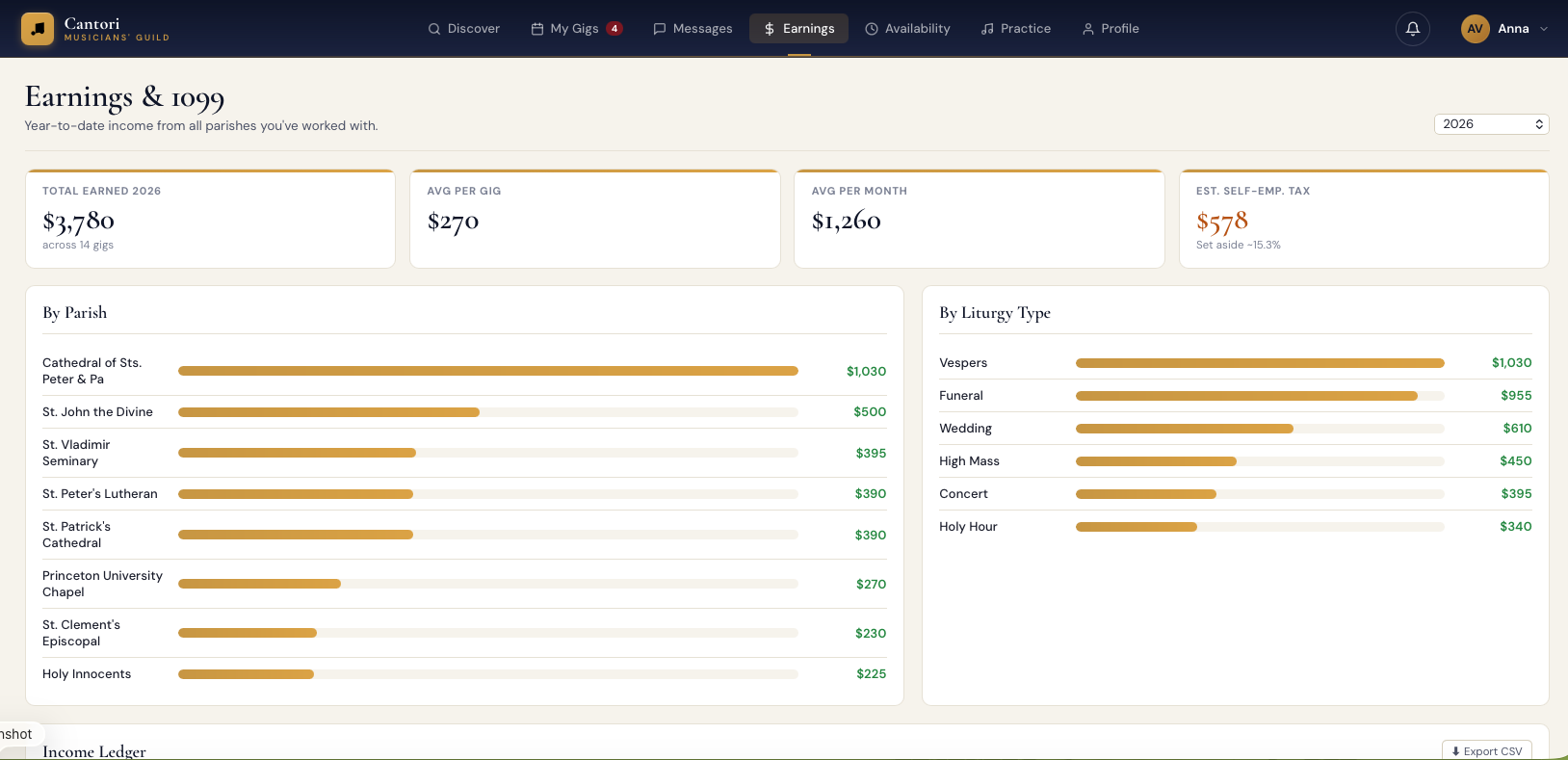
Cantori builds the professional layer the Catholic and Anglican sacred music world has never had: verified musician profiles, intelligent director tools, structured contracts, Stripe Connect payouts, and automated 1099 generation — all designed with the vocabulary and norms of the tradition.

Musician Profiles
Searchable by what actually matters
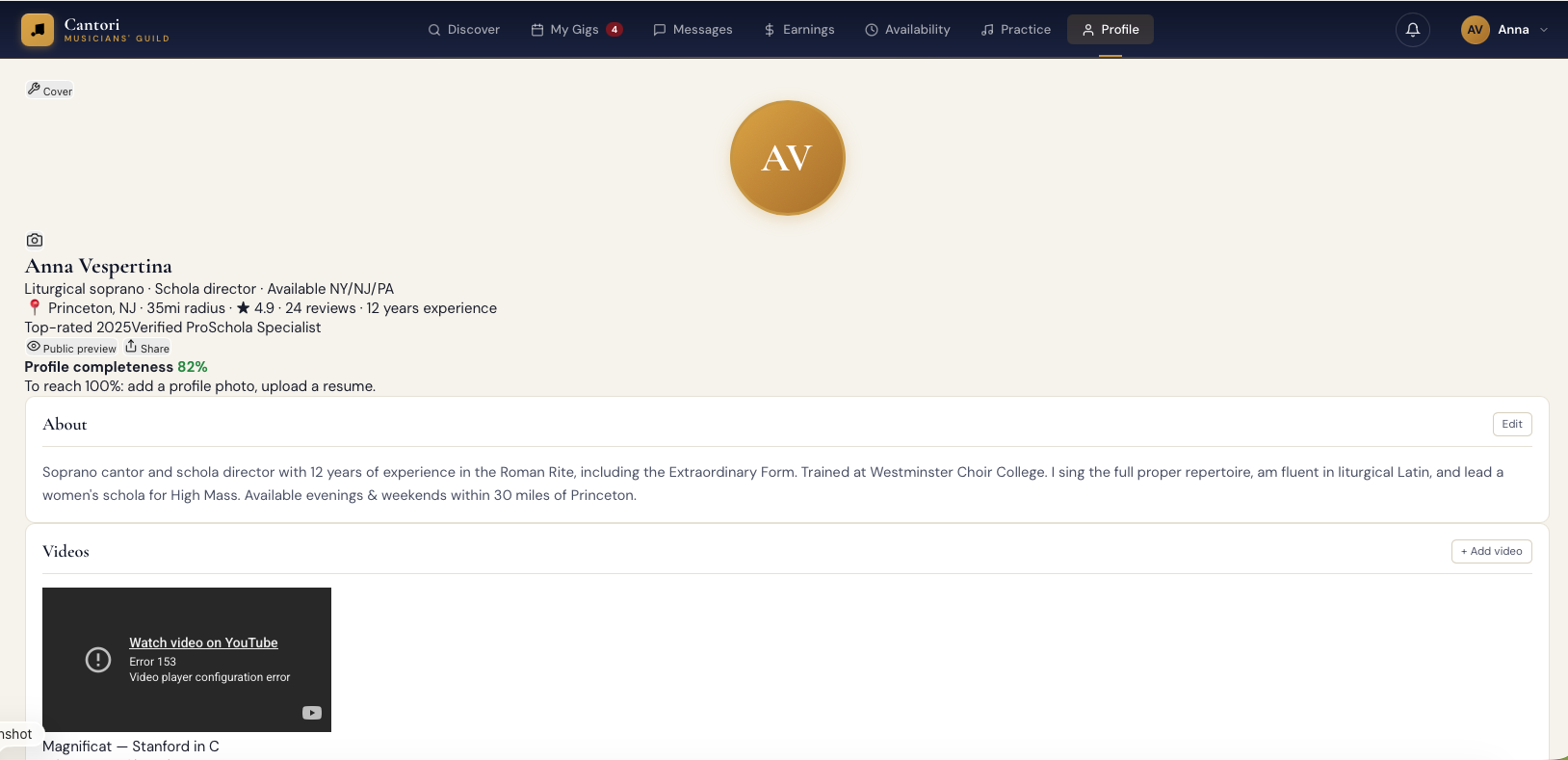
Voice part, choral repertoire (polyphony, Gregorian, contemporary), instrument, geography, availability, and liturgical rite. Musicians own their professional identity.
Director Tools
Search, contract, and schedule in one place
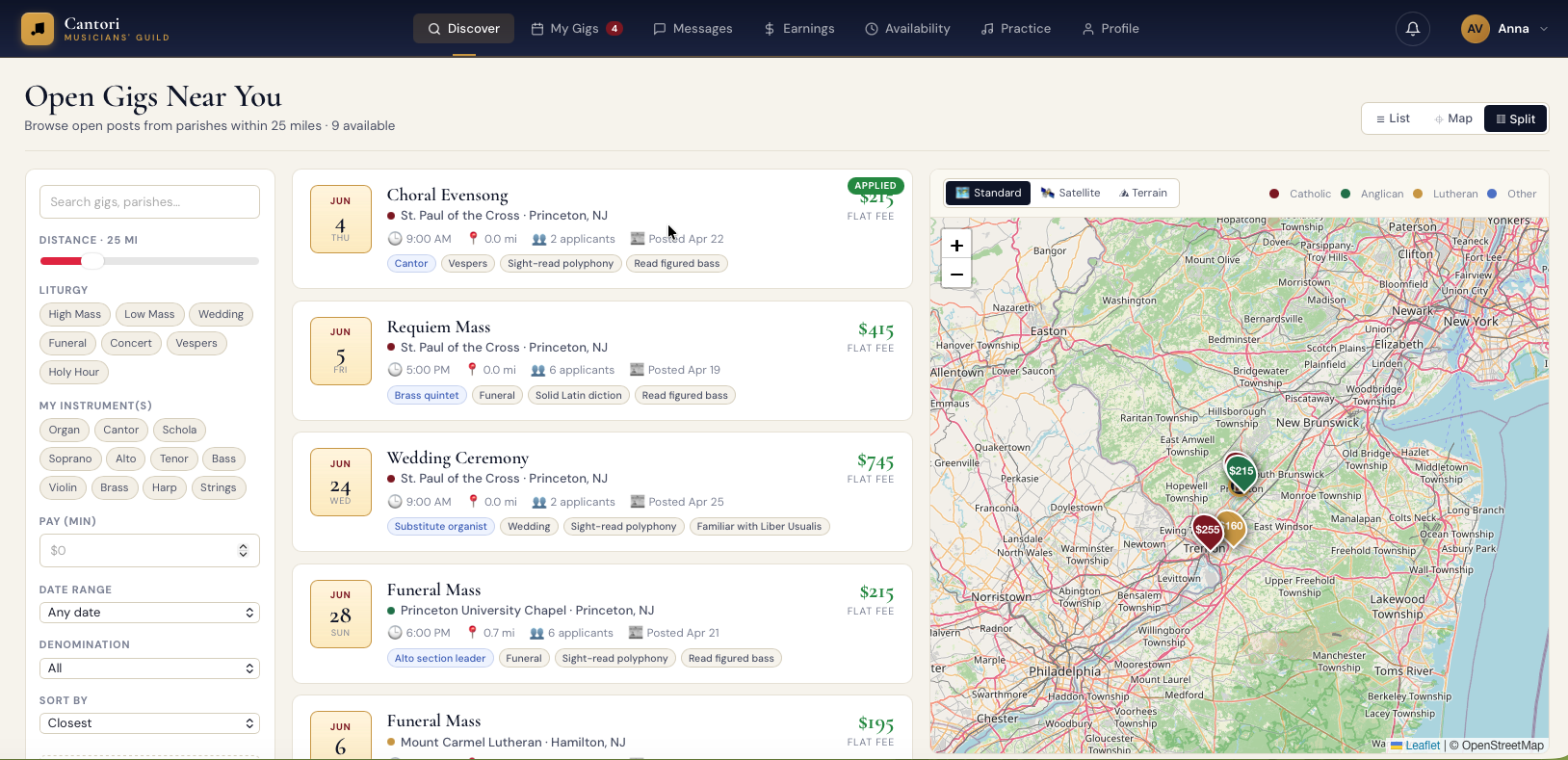
Directors find vetted candidates, issue service contracts, and manage liturgical calendar scheduling — replacing email chains with structured workflow.
Stripe Connect Payouts
Compliant disbursements from day one
Churches pay through Cantori. Musicians receive funds directly. 1099-NEC generation is automatic. No Venmo, no checks, no compliance gaps.
Repertoire Planning
Liturgically aware scheduling
Propers, Ordinary, feast days, liturgical seasons — Cantori understands the calendar and matches repertoire requirements to available musicians.

Product in Detail

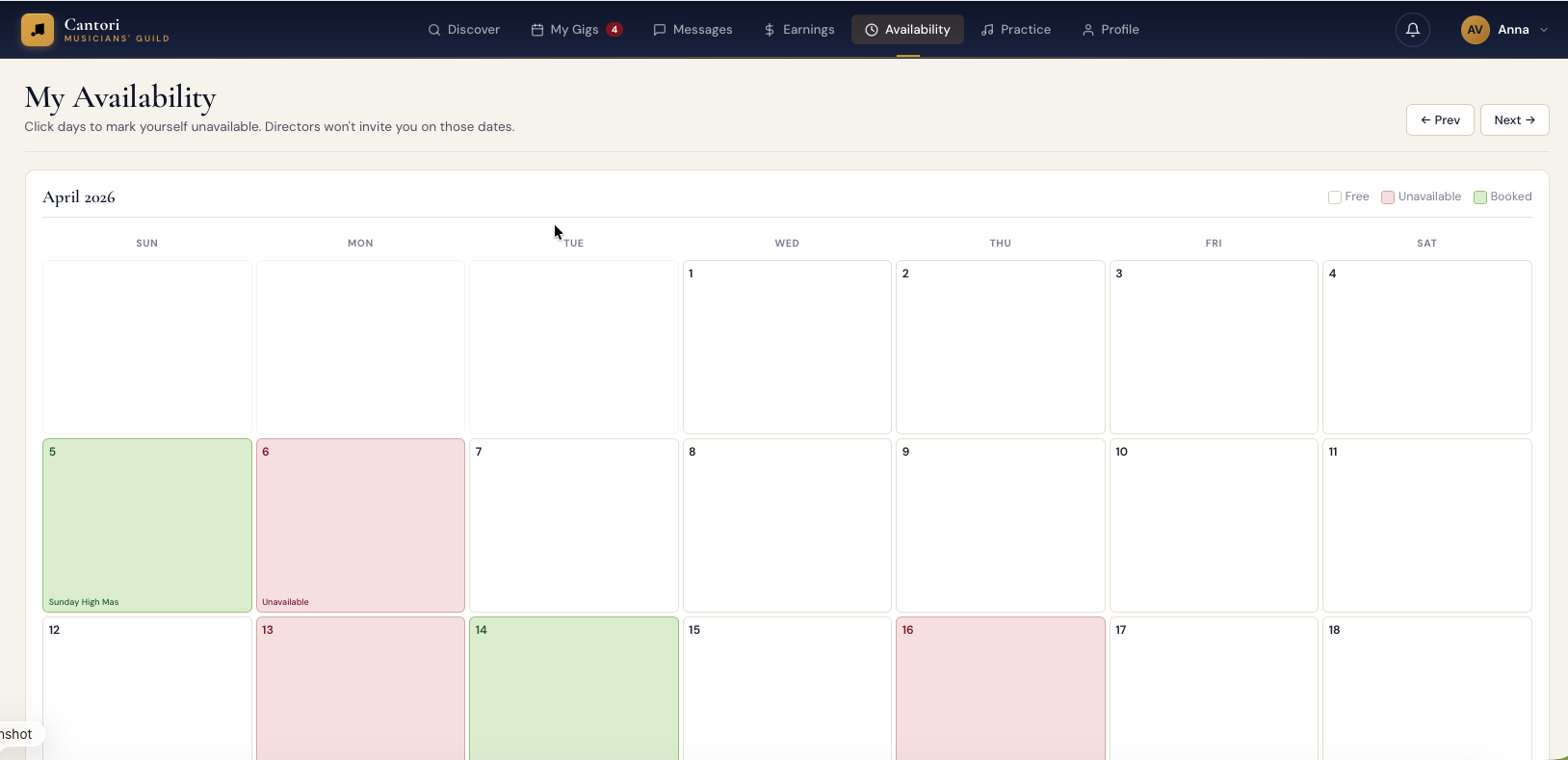
Eighteen views. Two sides.
One integrated platform.

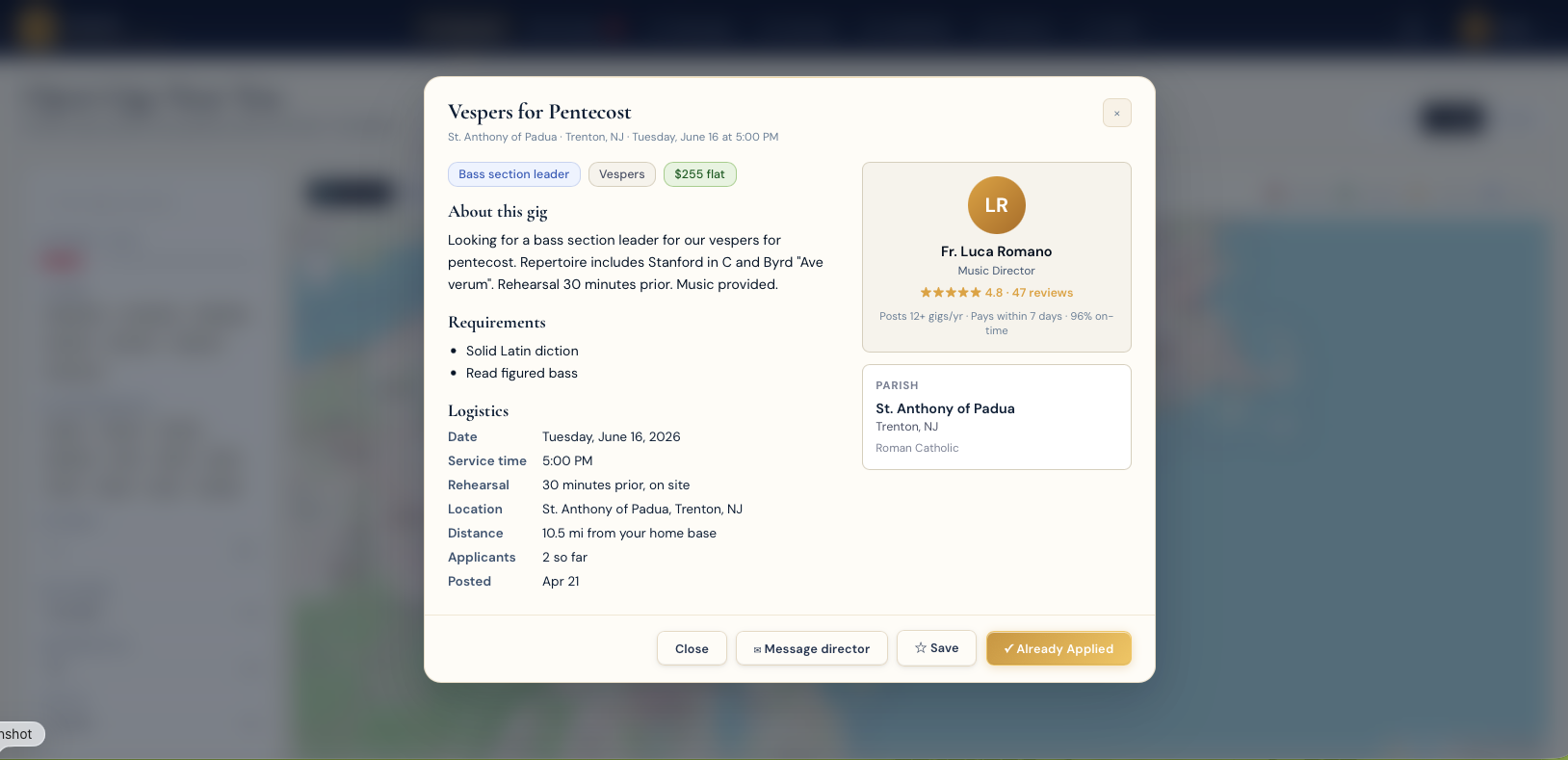
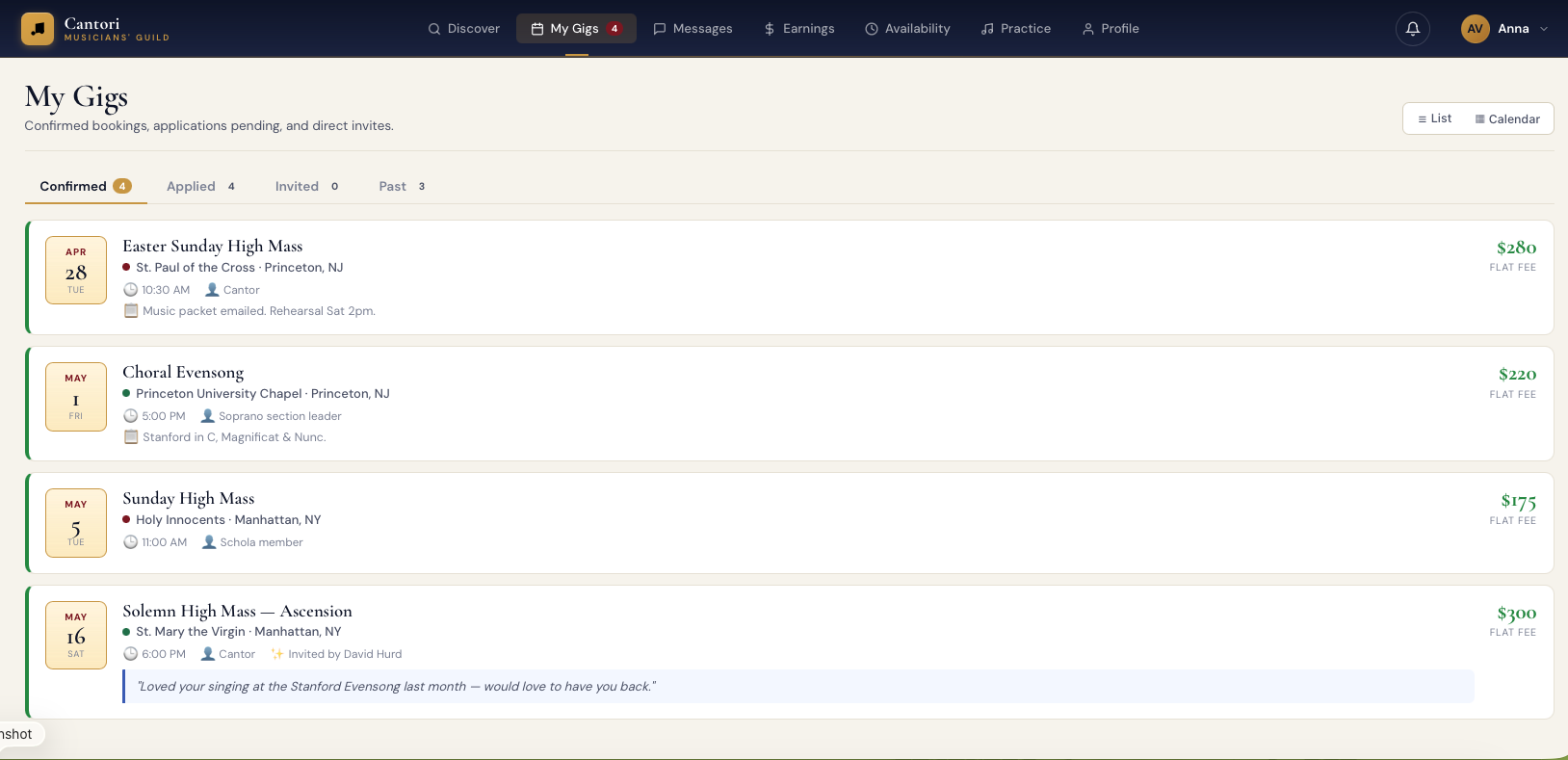
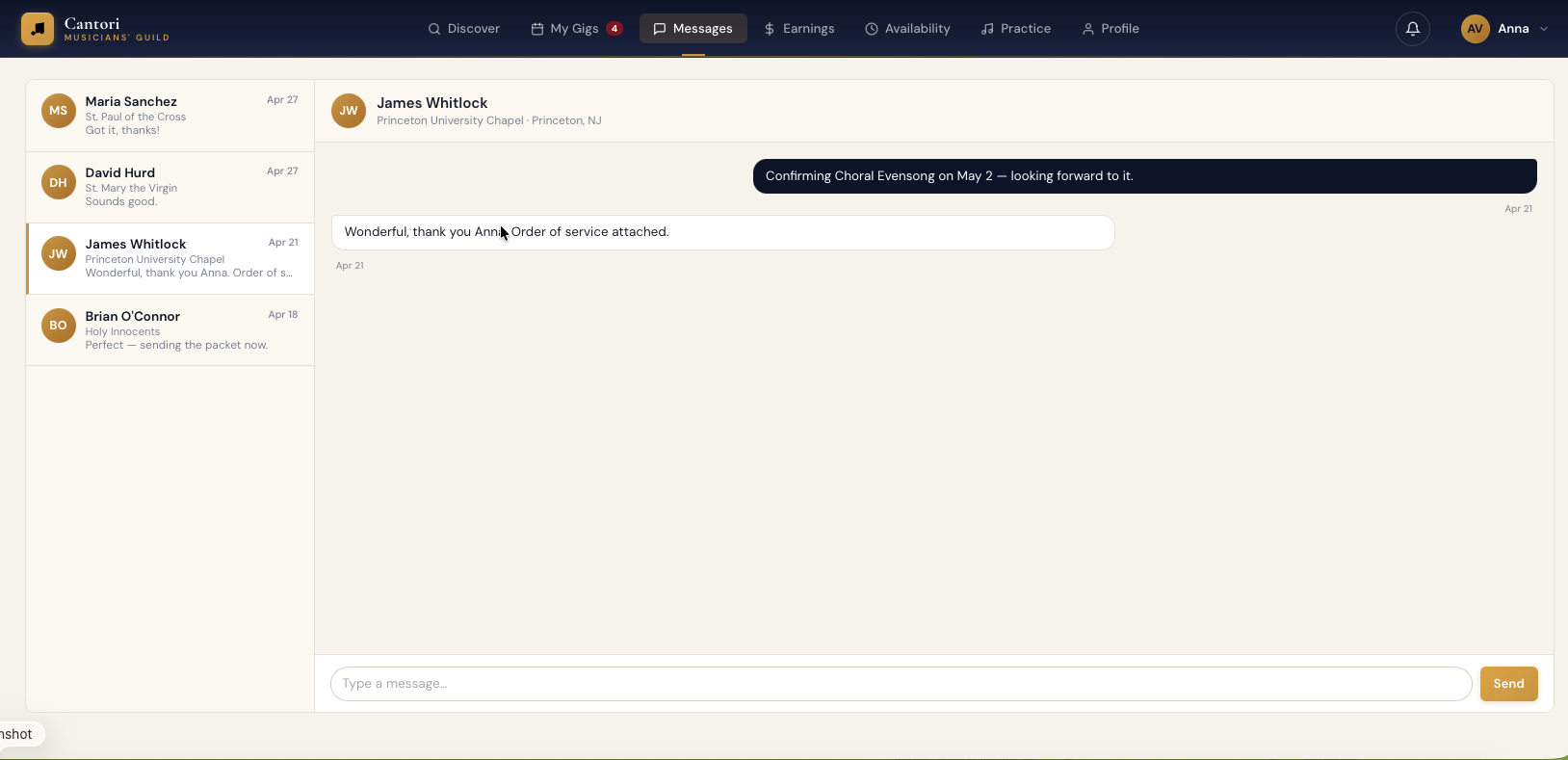
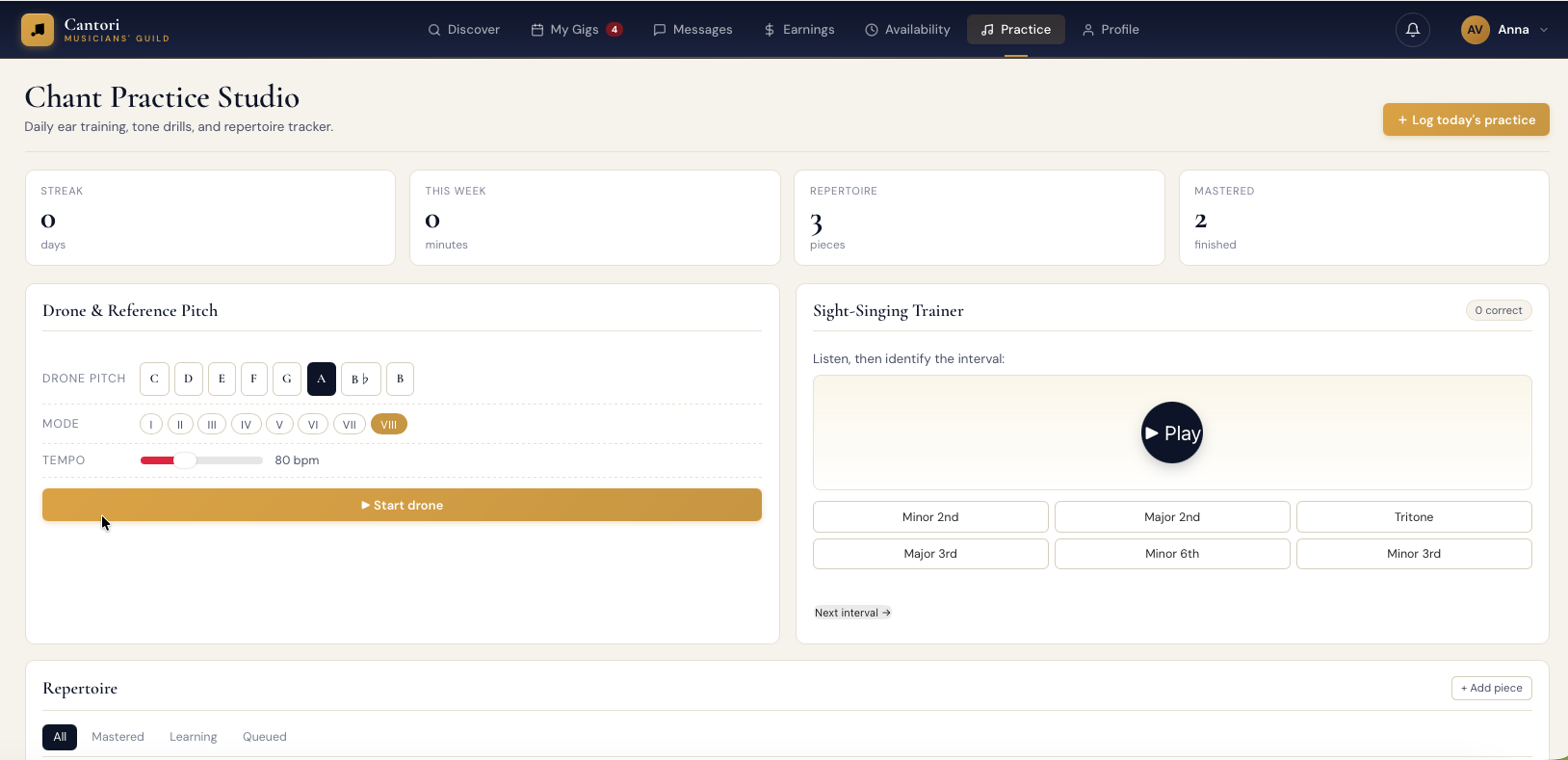
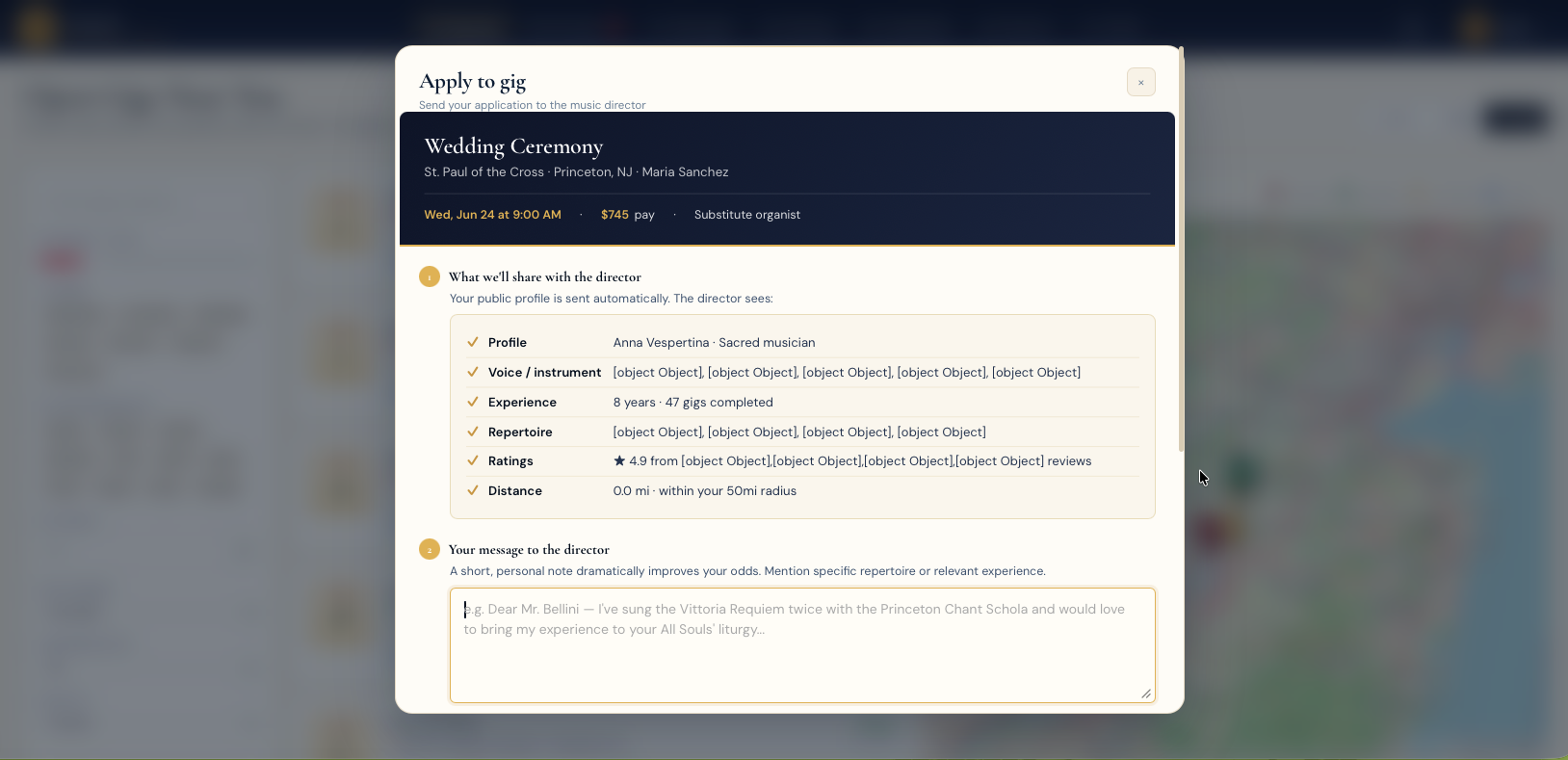
Every screen below is a functional part of the v5 Cantori application. These are not wireframes — they are working views from both sides of the marketplace, built with the vocabulary and workflow of the liturgical music tradition.

For Directors

For Musicians

Market

$48M serviceable opportunity
with a defensible wedge

$420M TAM — all sacred music labor (US)
$120M SAM — Catholic + Anglican liturgical
$48M SOM — Catholic + Anglican high-church parishes (3 years)

The primary market is the 17,000+ U.S. Catholic parishes, with a focused wedge in high-church Catholic communities — Extraordinary Form, solemn Ordinary Form, and Ordinariate — plus Anglican, Episcopal, and Lutheran high-church congregations. Roughly 3,000 of these parishes operate with high musical standards, committed budgets, and acute musician shortages. They have above-average director sophistication and willingness to pay for professional tooling.

Market math: 3,000 high-church parishes × average $4,000 annual music labor spend through platform × 5% take rate = $600K ARR from the wedge alone. Director subscription adds $360–600K. These are conservative figures for a single segment; the broader Catholic and Anglican market is 10× larger.

The wedge works because high-church communities are interconnected through CMAA, NPM, and diocesan networks — word of mouth travels fast. One cathedral using Cantori for the Triduum reaches every serious musician and director in the diocese. The platform's vocabulary — Propers, Ordinary, liturgical rites, feast-day scheduling — is native to all of these traditions.

Total Addressable Market $420M / year
Serviceable Addressable Market $120M / year
Serviceable Obtainable Market (3yr) $48M / year

Competitive Landscape

No competitor is built for
this world

Facebook Groups, the NPM directory, and general job boards serve different markets with different vocabularies. Cantori is purpose-built for liturgical music hiring — every feature below reflects the actual workflow of a parish music director.

Full feature built in
Partial or manual workaround
Not available
Feature Cantori Facebook Groups NPM / CMAA Directory General Platforms
Liturgical calendar integration
Automated disbursements (Stripe Connect)
Automated 1099-NEC generation
Score & repertoire library (150+)
Denomination-aware search & matching
Practice tools (sight-singing, metronome, drone)
Commission-based revenue model
Purpose-built for sacred music
0
U.S. Catholic Parishes
$0
Pre-Seed Raise
0
Scores in Library

Traction

Pre-revenue with a qualified pipeline

Business Model

Two revenue streams,
neither dependent on the other

Revenue stream Structure Target
Director Subscription $30–$50/month per music director. Unlocks full search, contracts, scheduling, and analytics. ~1,200 paying directors in year 2 = $540K ARR
Platform Fee on Payouts 5–10% on all musician disbursements processed through Cantori. Stripe Connect handles splits automatically. $2M gross payout volume × 7% = $140K ARR (year 2)
Musician Tier (free) Free musician profiles drive supply-side liquidity. No charge to musicians at launch — keeps acquisition frictionless. Network effect foundation; premium tier possible in year 3

Year 2 combined ARR target: $680K. Contribution margin is high — the platform is software-mediated with minimal per-transaction variable cost beyond Stripe fees. Unit economics improve rapidly with musician supply density.

Future & Funding

Where we're going —
and what $75K builds

1
Now — Pre-Seed
Design partners, waitlist & investor conversations
9 design-partner parishes in active conversation. Waitlist building across the Catholic and Anglican sacred music community. Working prototype complete. Pre-seed round open.
2
Post-Funding — Months 1–12
Full network launch — 100+ musicians, 50+ directors
Stripe Connect payouts live, 1099 automation deployed, full director search and scheduling tools. Design partner churches live with real transactions. First paid subscriptions. CMAA conference presence for supply acquisition.
3
Year 1–2
Multi-diocese expansion & conference partnerships
Formal partnerships with CMAA and NPM. Seminary integrations — Cantori as the professional platform for graduating liturgical music students. Catholic media campaigns. $100K ARR milestone. Series A preparation.
4
Year 2–3
National scale, denomination expansion, international
Full U.S. Catholic and Anglican coverage. Denomination expansion into Episcopal, Lutheran, and Eastern Rite communities. International pilot in UK and Irish Catholic communities. Platform revenue at sustainable scale.
Raising $75K Pre-Seed
The round funds eighteen months of focused execution
2 engineers hired — full-stack and mobile, building the platform and iOS presence
12-month full-time runway for Guillermo — product, BD, and community leadership without distraction
Marketing spend for first 1,000 musicians and 200 directors — Catholic media, diocesan outreach, referral campaigns
Conference presence — CMAA, NPM, and SENT Summit, where the core audience concentrates annually
Legal — incorporation, IP filings, platform compliance, and contract template review

Use of Funds

Engineering 40% $300K
Two full-stack + mobile engineers. Platform, Stripe Connect, contracts, search, 1099 automation.
Operations & Founder Salary 25% $187K
Full-time founder salary (12 months), tools, infrastructure, and design partner success program.
Marketing & Growth 20% $150K
Catholic media, CMAA / NPM / SENT Summit conference presence, diocesan BD, and musician acquisition campaigns.
Legal & Compliance 10% $7.5K
Incorporation, IP filings, platform contract templates, 1099 compliance counsel.
Reserve 5% $38K
Contingency for unexpected engineering scope, compliance requirements, or accelerated market opportunity.
Why Now
17,000+ U.S. Catholic parishes.
Zero professional hiring infrastructure.
Directors still post on Facebook groups and call friends when a Mass musician cancels. Musicians piece together income from three part-time roles arranged by text message. The market has existed for decades — but post-pandemic, professional standards are rising, parishes are rebuilding music programs, and the community's tolerance for the informal system is exhausted. Cantori is the platform this tradition has been waiting for, and the timing is right.
Interested in investing?
Reach Guillermo directly at cantori@polsia.app for the data room, deck, or to schedule a 30-minute call. The full investor dossier — including product detail and 3-year model — is at /investors.

Founder

Why this founder for this market

Guillermo Pasarin
Founder & CEO, Cantori

Guillermo is an insider. He did not discover the sacred music hiring problem by reading a market report — he lived it. A trained liturgical musician with years of experience in Catholic choral settings, he has been on both sides of the informal hiring system: scrambling to find qualified musicians for feast-day Masses, and navigating the fragmented network of referrals as a working musician himself.

That combination — practitioner knowledge of the tradition plus the technical ability to build the platform — is the rarest combination in any vertical network. Domain credibility matters here in a way it does not in generalist software. CMAA members and parish music directors will trust Cantori because they trust someone who knows what a Propers setting is, who understands why a vocalist's sight-reading ability matters more than their streaming-era resume, and who can speak with parish administrators in the language of liturgy rather than startup jargon.

Guillermo is building this full-time. The market timing is favorable: post-pandemic, parish music programs are rebuilding and professional standards are rising. The combination of a qualified founder, a community-backed brand, and an acute problem with no existing solution is a pre-seed bet that makes sense.

Pitch Deck

Full deck available on request

The pitch deck covers the full product narrative, wireframes, competitive landscape, and 3-year financial model. Request access via email or schedule a call below.

Deck available — contact founder to access

Investor FAQ

The questions we expect

Is the market large enough to build a venture-scale business?
Not at the highest end. Cantori is built as a high-margin, capital-efficient platform — not a billion-dollar TAM play. The $48M SOM with strong contribution margins produces a compelling outcome for a pre-seed check without requiring planetary-scale assumptions. The right framing is: exceptional product/market fit in a defensible vertical, building to a strong strategic acquisition outcome (diocese software vendors, church management platforms) or a durable mid-market SaaS business.
Why can't an incumbent just add this feature?
Church management platforms (Planning Center, Breeze, ChurchTrac) handle administration — giving, attendance, volunteer scheduling. None of them understand liturgical music hiring. Adding a two-sided professional network with Stripe Connect payouts, 1099 generation, musician profiles, and repertoire search to an administrative platform would be a fundamental product re-architecture. The domain knowledge required to build it correctly is not in their organization.
How do you build supply (musicians) and demand (directors) simultaneously?
The chicken-and-egg problem is manageable here because the communities overlap and communicate. Directors and musicians attend the same CMAA conference, follow the same publications, and know each other personally. We seed supply first — free musician profiles — and use design partner churches to drive immediate demand into that supply. The first 9 churches create real jobs on the platform within 60 days of launch.
What's the competitive moat?
Three layers: (1) Network density — musicians concentrate on the platform where jobs are; directors come where musicians are. First-mover advantage in a tight community is durable. (2) Domain vocabulary — Cantori is built with the language of the tradition (Propers, Ordinary, liturgical rites, CMAA certification). A generic platform cannot replicate this without rebuilding from scratch. (3) Trust — the sacred music community is relationship-driven and reputation-sensitive. A platform that earns trust with CMAA leadership becomes the default by word of mouth.
What happens if diocesan policy changes reduce demand in any single segment?
No single segment is the ceiling. Cantori serves all forms of the Roman Rite — Ordinary Form, Extraordinary Form, Ordinariate, Anglican Use — plus Anglican, Episcopal, and Lutheran high-church communities. The product is built around liturgical music broadly; the vocabulary of Propers, Ordinary, and choral repertoire is shared across all of these traditions. A policy shift in any one segment would slow acquisition there but would not affect the others, which together represent a market an order of magnitude larger than any individual community.
What does the 18-month roadmap look like?
Months 1–6: Design partner onboarding (9 churches), MVP launch (search, profiles, contracts, payouts). Months 7–12: Product iteration based on partner feedback, first paid director subscriptions, 1099 automation live. Months 13–18: CMAA conference launch, Catholic media campaign, 50+ paying churches, $100K ARR milestone, Series A prep.
Why raise $75K and not more?
We sized the round to fund the immediate next steps: completing the platform, onboarding design partners, and proving product-market fit with first paying directors. $75K covers engineering polish, initial outreach to Catholic music communities, and gives Guillermo runway through the CMAA conference launch. Revenue from early directors funds the next phase — we raise to Series A metrics from a position of traction, not assumption.
What are the top three risks?
First, supply density in year one — if musician profiles are thin at launch, director search underwhelms. We mitigate with direct outreach to CMAA members before opening public sign-ups. Second, director willingness to pay before the network reaches critical mass — we use the design partner program to demonstrate ROI before public pricing. Third, Stripe Connect compliance for religious organizations — church treasurer workflows have specific ACH and reporting requirements; we're engaging counsel early to ensure compliant disbursement structures.

Ready to be part of
the Sacred Music Network?

Guillermo is actively raising $75K pre-seed and meeting with investors who understand the liturgical music market. Schedule a call or reach out directly.

Schedule a Call with Guillermo

Or email cantori@polsia.app directly

Round Pre-Seed — $75K
Founder Guillermo Pasarin
Founded March 2026